

An alumni database is more than a list of graduates and their contact details. It helps an education foundation understand its community, connect students with mentors, organize volunteer opportunities, and build relationships that last beyond graduation.
Imagine a student looking for a mentor in law. Your school may already have several graduates working in that profession, but their information is scattered across old spreadsheets, event registration lists, and individual staff files. Finding the right person becomes a time-consuming task instead of a simple search.
This is one of the challenges of managing alumni information without a centralized system. As your alumni network grows, keeping records organized and accurate becomes increasingly important. The goal is not just to store information, but to make it useful for your foundation’s mission.
The Hidden Risks of Managing Alumni Information in Spreadsheets
Spreadsheets are a reasonable place to start an alumni program. They are familiar, flexible, and easy to use. However, as a foundation collects more information, managing everything manually can become difficult.
When Alumni Records Are Scattered Across Multiple Files
Your foundation might keep one spreadsheet for reunions, another for volunteers, and a separate list of alumni who have given. Each file holds useful information, but none of them shows the full picture of your alumni community.
The same graduate might appear in multiple files with different email addresses, while an important note about their interests remains in someone’s inbox. Staff must search across sources to determine which information is current.
A centralized database brings these records together, making it easier to find information and maintain a consistent view of each alumnus.
For more guidance on locating graduates and bringing scattered records together, read Your Alumni Are Out There: How to Find Them and Reconnect.
How Outdated Information and Manual Updates Create Extra Work
Alumni move, change jobs, update their contact details, and develop new interests. A record that was accurate at graduation may no longer be useful several years later.
When updates depend entirely on manual work, staff must identify outdated details, correct records, and make sure those changes are reflected everywhere. Updating one spreadsheet but forgetting another can create inconsistencies that affect future outreach.
Establishing clear procedures for verifying contact information and removing duplicates makes this work more manageable. Alumni Nations’ data services can also help foundations clean, organize, and enrich existing alumni records.
Protecting Institutional Knowledge When Staff Changes
An alumni coordinator may know which graduates enjoy volunteering, who has mentored students, and which alumni prefer a personal phone call instead of an email.
When this knowledge exists only in someone’s memory or personal files, it can become difficult to recover when responsibilities change hands.
A centralized database helps preserve this institutional knowledge by documenting contact details, interests, and interaction histories. With clear procedures for maintaining those records, a new staff member can continue building relationships instead of starting from scratch.
What Disconnected Alumni Data Can Cost Your Foundation

The costs of disconnected information do not always appear on a budget. They often show up as wasted staff time, missed connections, and limited visibility into program outcomes.
Wasted staff time. Searching through files, correcting inconsistencies, and rebuilding contact lists takes time away from planning events and developing alumni relationships.
Missed connections. A graduate who could mentor a student, speak at a career event, or volunteer at a school activity may be overlooked because their professional background or interests are not recorded in an accessible place.
Inefficient outreach. Incomplete contact details can lead to unsuccessful messages. Without reliable information about graduation years, locations, or interests, it is also harder to make communications relevant to different alumni groups.
Difficulty measuring outcomes. When event attendance, mentoring activity, and volunteer participation are tracked separately, foundations may struggle to understand which programs are working and where additional support is needed.
These challenges can make it harder to demonstrate the value of alumni engagement to school leaders, boards, and community partners. Better-organized information gives foundations a stronger starting point for understanding their progress.
For a closer look at how administrative work can take time away from relationship-building, explore The 5 Tasks You’re Doing That Alumni Nations Should Be Handling.
From Contact Lists to Actionable Alumni Information
A useful alumni database does more than store names. It helps staff answer practical questions: Who might mentor a student? Which graduates are interested in volunteering? What support do alumni need?
Finding the Right Alumni for Mentorship and Volunteering

Mentorship programs become easier to coordinate when staff can search for alumni by profession, location, skills, or interests.
In an interview with Yisel Romero, Alumni Center Lead, she described how Alumni Nations helped organize alumni information and filter graduates to find relevant connections, including identifying a potential mentor based on their profession.
Her example illustrates how structured information can turn an alumni network into a practical resource for students. Rather than searching through separate lists, a coordinator can identify graduates whose experience aligns with a student’s goals and reach out with a relevant opportunity.
Understanding Alumni Needs and Support Trends
Alumni information can also help foundations identify recurring needs. For example, tracking requests for scholarship information, financial aid guidance, or support transitioning from a two-year to a four-year program may reveal areas where students and alumni need additional help.
Individual records help staff respond to specific people. Looking at patterns across records can help foundations make informed decisions about resources, outreach, and future programs.
The important step is to collect relevant information consistently and use it to improve support, rather than gathering data without a clear purpose.
Keeping Contact Records Useful and Up to Date
Data quality is an ongoing responsibility, not a one-time cleanup task.
Foundations can create simple opportunities for alumni to confirm their information during reunion registration, event check-ins, newsletter campaigns, and other interactions. When appropriate, an alumni website can also allow graduates to update their own profiles.
Regular reviews help staff identify outdated contact details, unresolved duplicates, and incomplete records before those issues interfere with outreach.
If your foundation needs help locating graduates who have become difficult to reach, see how to find and reconnect with alumni.
What to Look for in a Centralized Alumni Database
The right platform depends on your foundation’s goals, resources, and existing technology. Look for a system that makes information easier to maintain, search, protect, and use.
The Essential Information to Include in Alumni Records
Start with the information your team needs to communicate with graduates and support your programs. Depending on your goals, useful fields may include:
- Name, school, and graduation year.
- Email address, phone number, and other relevant contact details.
- Date contact information was last confirmed.
- City, state, and professional interests, where appropriate.
- Mentoring, volunteering, event participation, and other engagement history.
- Communication preferences and opt-out status.
Not every record needs to contain every field. Collect information that serves a legitimate purpose, and avoid unnecessary sensitive personal details.
Organizing and Filtering Records for Targeted Outreach
A centralized database should make it easy to group alumni by graduation year, location, professional background, interests, or past participation.
For example, a foundation organizing a career day could identify local graduates working in healthcare and invite those interested in volunteering. A reunion coordinator could prepare a list of graduates from a particular class without rebuilding it from several files.
Targeted records also support more relevant communications. For additional guidance, see Alumni Nations’ article on why generic alumni newsletters often fall short for K12 foundations.
Alumni Nations’ database tools offer centralized records, customizable fields, and features that support searching, communication, and reporting.
Maintaining Data Quality, Privacy, and Appropriate Access
A reliable database requires clear rules about who can access and update information.
Foundations should limit access according to staff responsibilities, honor communication preferences and opt-outs, and establish a regular schedule for reviewing records. Sensitive information should not be stored in unrestricted notes or routinely distributed through exported spreadsheets.
When alumni information comes from school or district records, coordinate with the appropriate school personnel to ensure that sharing and use comply with applicable privacy requirements.
These practices help protect alumni while giving staff the information they need to do their work.
Connecting Alumni Data With Existing Systems
Before selecting a platform, consider the tools your foundation already uses, such as student information systems, email platforms, event registration software, fundraising tools, and website forms.
Determine what information needs to move between these systems and whether integrations are available. When direct integration is not practical, a consistent process for importing and exporting records may be sufficient.
The objective is to reduce unnecessary duplication and manual entry, not introduce another disconnected tool.
Reporting on Engagement and Program Outcomes
A useful database helps foundations measure progress toward their goals. Relevant indicators might include:
- The percentage of alumni records with verified contact information.
- Event attendance by graduation year.
- The number of mentors matched with students.
- Volunteer participation over time.
- Alumni responses to outreach campaigns.
Choose a few measures that reflect your foundation’s priorities and review them consistently. A larger database does not automatically mean stronger engagement, but reliable records can help staff understand participation and identify opportunities to improve their programs.
How to Modernize Your Alumni Database Without Losing Valuable Information
Modernizing your database does not have to happen all at once. A structured transition helps preserve useful information while reducing the risk of carrying old problems into a new system.
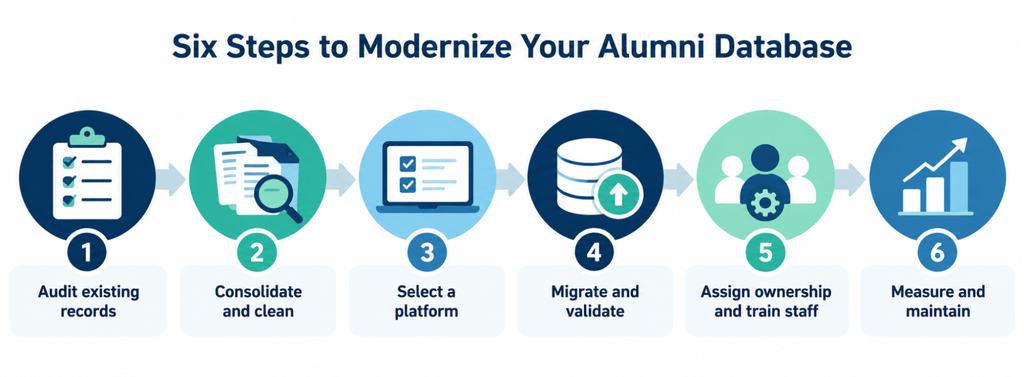
1. Audit existing spreadsheets, files, and databases.
Identify where alumni information lives, who maintains each source, and which records appear most reliable. Note duplicate lists, missing details, and sensitive information. Keep a secure backup before making changes.
2. Consolidate records, remove duplicates, and establish consistent fields.
Standardize formats for names, graduation years, contact details, and other essential fields. Review potential duplicates carefully before merging records so useful information is not lost. For complex or incomplete records, Alumni Nations’ data services can help with data cleaning and deduplication.
3. Select a platform that fits your foundation’s goals, resources, and integration needs.
Consider who will use the system, which features are essential, how much support your team needs, and which existing tools it must work with. Choose a platform your staff can realistically maintain.
4. Migrate and validate the data while protecting sensitive information.
Test the migration with a sample before moving all records. Confirm that names, contact details, graduation years, and engagement histories transferred correctly. Restrict access during the transition and use secure methods to handle personal information.
5. Assign responsibility for updates and train staff.
Name someone responsible for data quality, even if several people contribute updates. Document how staff should add records, correct information, record interactions, and honor communication preferences. Training helps keep these practices consistent when responsibilities change.
6. Measure results and maintain data quality over time.
Review record accuracy regularly and track outcomes connected to your goals. Look for changes in verified contact details, outreach efficiency, event participation, or mentoring activity. Once the new system has been validated, retire outdated working spreadsheets to reduce the risk of staff returning to inconsistent sources.
For support with the operational processes behind these changes, explore Alumni Nations’ operations services.
Make Your Alumni Data Work Harder for Your Mission
Your alumni records represent people who can mentor students, volunteer, support school initiatives, and help future graduates succeed.
When information is organized and maintained consistently, your foundation can spend less time searching through files and more time creating meaningful opportunities. Better records also provide a clearer view of alumni needs, engagement, and program outcomes.
You do not have to modernize everything overnight. Start by identifying where your information lives, deciding what your foundation needs to know, and establishing a manageable process for maintaining records.
Ready to move beyond spreadsheets? Explore Alumni Nations’ database tools and alumni data services to see how a more organized alumni database can support your foundation’s mission.