
You hit send on the fall newsletter, and the replies never come.
To increase alumni engagement after your list goes quiet, run a short re-engagement campaign in three steps. First, clean your list and sort quiet contacts by when they last engaged. Next, send a reconnect message that asks for nothing. Then invite one small action, like updating their contact info. Start now, before year-end giving begins.
A quiet list feels personal, but it usually isn’t. Many graduates who go silent haven’t written off your school. They moved, changed email addresses, got busy, or learned to expect that every message would be an ask.
That makes “ghosting” a contact problem and a relevance problem, and your team can fix both. This guide is for K12 education foundation leaders, school alumni coordinators, and district communications teams who want to reconnect with quiet graduates before December.
In this guide
- What alumni “ghosting” looks like and how to spot it
- Why reconnect before year-end giving
- Strategy 1: Clean and sort your list
- Strategy 2: Reconnect without asking for anything
- Strategy 3: Invite one small action
- Your week-by-week fall plan
- How to measure results
- Short on time, staff, or data?
- FAQ
What does it mean when alumni are “ghosting” your school?
Alumni ghosting is when graduates on your list stop opening, clicking, replying, or showing up, without unsubscribing or telling you why. In K12, it usually traces back to one of four simple causes:
- Outdated contact information. Many districts close student email accounts after graduation. Graduates move to college, work, and personal addresses your list never learns about.
- Messages that only ask. If the last three emails were requests, the fourth one gets skipped.
- Content that feels generic. A Class of 1985 graduate and a Class of 2022 graduate want different things from you.
- No rhythm. Months of silence followed by a burst of emails reads as “they only call when they need something.”
Supporters going quiet is common across the nonprofit sector, not just in schools. M+R Benchmarks 2026, an annual study of nonprofit online fundraising, found that only 48% of people who made a one-time online gift in 2024 gave online again in 2025. Roughly half didn’t give online again, and that doesn’t count the supporters who simply stopped reading.
For a broader five-step approach to winning back disengaged graduates, see our guide to reconnecting disengaged alumni. This guide is the timed version: a short campaign you can run between late October and December 31.
Running alumni outreach as a team of one? Book a demo with Alumni Nations to see how K12 teams send updates to specific class years from one platform.
How can you tell if your alumni list has gone quiet?
Your alumni list has gone quiet when fewer people click, reply, give, or attend than a year ago, and more emails bounce. Compare this fall to last fall. Your own history is a better yardstick than any industry average, because no two K12 lists look alike.
- Falling clicks. Fewer people click newsletter links than last fall. The content usually doesn’t match what this group cares about.
- Rising bounces. More emails come back undeliverable. Contact information is out of date.
- Lapsed givers. People who contributed last year haven’t yet this year. They need a thank-you and an update before another invitation.
- Few replies or RSVPs. Event invitations and surveys get little response. You may be asking more often than you’re sharing.
- No profile updates. No one has changed an address or job in a year or more. Alumni don’t see a reason to keep their information current.
A lapsed giver is anyone who contributed in a past year but hasn’t yet this year. Lapsed givers are one of the most important groups on your list, because they’ve already shown they care about your students.
Treat email open rates as a rough trend line. For Apple Mail users, Apple says Mail Privacy Protection downloads remote content, such as images, in the background by default when a message arrives, whether or not the reader engages with it. That can make opens look higher than they are, so clicks, replies, and real actions are a truer read on who is still listening.
Why reconnect with alumni before year-end giving season?
Reconnecting with alumni in the fall means your year-end invitation reaches graduates who just heard a warm hello from you. The people most likely to support your students this December are the ones who already feel close to your school.
Timing matters, too. M+R Benchmarks 2026 found that nonprofits received 37% of their 2025 online revenue in December, and the last day of the year alone brought in 4%. Giving Tuesday falls in December in 2025, and it lands in December again this year. Thanksgiving is November 26, so Giving Tuesday is December 1, 2026.
Reconnecting with past contributors also matters more than finding new ones. The same M+R study found that 66% of prior online donors, people with a recent giving history, gave online again in 2025. Only 24% of 2024’s new online donors did the same. A graduate who gave once is a relationship worth tending.
The Fundraising Effectiveness Project’s 2025 year-end report, released in April 2026, points the same way. Dollars raised grew about 5% in 2025, but the number of donors fell 3.6%. Woodrow Rosenbaum, chief data officer of GivingTuesday, said that “converting first-time givers into long-term supporters remains the sector’s most pressing challenge.”
None of this makes your alumni a number to hit. It means the graduates who care about your students deserve a real hello before they hear about year-end needs.

Strategy 1: Clean and sort your alumni list before you send anything
The first re-engagement step is knowing who you can actually reach. A warm message sent to a stale list wastes your best moment, and a pile of bounces can make email providers more cautious about delivering your next send.
Lists also decay faster than most teams expect. M+R Benchmarks 2026 found that 4% of nonprofit email subscribers at the start of 2025 became unreachable because of bounces, and another 12% unsubscribed during the year.
Work through your alumni list in this order:
- Pull 12 months of activity. Export clicks, replies, event RSVPs, contributions, and profile updates for everyone on the list.
- Fix what’s broken. Stop emailing addresses that have bounced. Then look for updated contact information through class reunion committees, classmates, social media, or a data update service.
- Sort everyone into groups. Simple beats perfect. Four groups are enough to start.
Talking to each group differently is one of the core alumni relations best practices. Active alumni stay on your normal rhythm. The quiet, ghost, and lapsed giver groups get a short, separate campaign, because the message that keeps an engaged graduate interested is rarely the one that wins back a quiet one.
If your list is thin, start anyway. A foundation with 300 good email addresses can run this campaign this week and keep building the list as replies come in.
While you’re cleaning, plan for next year’s graduates too. Ask seniors for a personal email address before graduation, in case their student account closes after they leave.
Strategy 2: Reconnect with a message that asks for nothing
Your first message to quiet alumni should offer something. A short note with a student story, a photo, or a piece of school news reminds graduates why they cared, without making them feel like a fundraising list.
Send it from a real person. A foundation director, a longtime teacher, or a well-known coach usually gets more attention than a generic “Alumni Office” sender. Then give readers one easy click: update their contact information, vote in a one-question poll, or share a favorite memory.
Match the reconnect message to the graduate’s life stage
Alumni at different life stages want different things from their school. Alumni Nations’ guide to alumni engagement strategies splits graduates by age. Those in their 20s are usually motivated by career growth and connections, while alumni over 35 lean toward giving back to the school that shaped them.
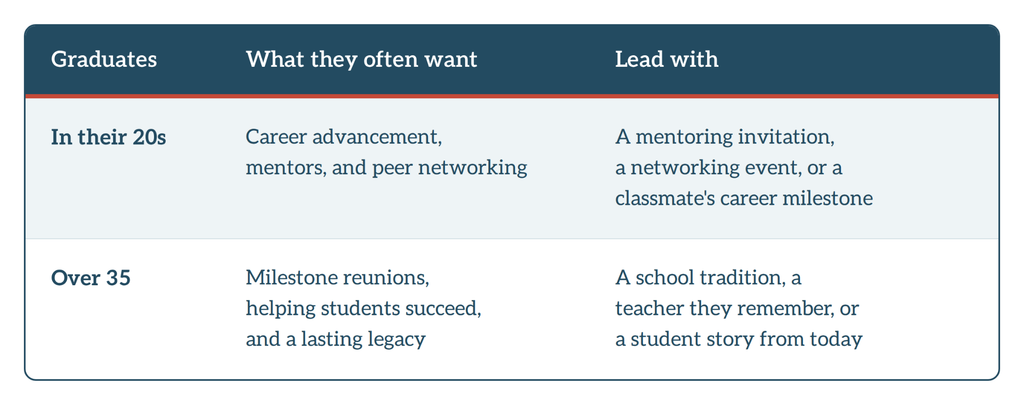
If you can only send one version, send the reunion-and-legacy version to roughly the Class of 2008 and earlier. Send the career-and-mentoring version to everyone after. Even that one split makes the message feel written for the reader.
Subject lines you can adapt
Subject lines for a reconnect email should feel specific and human:
- “Class of 2005, we’ve missed you”
- “The chemistry lab finally got an upgrade”
- “Still a [Mascot]? A quick hello from [School Name]”
- “A quick hello (no ask, promise)”
A sample reconnect email you can adapt
This sample no-ask email runs under 110 words. Swap in your own student story and keep the single link.
Subject: Class of 2005, we’ve missed you
Hi [First name],
It’s [Your name] from the [School Name] Education Foundation. No ask today, just a quick hello.
Last month, our robotics team took a robot they built themselves to the state competition for the first time. Half the team had never built anything before September. Watching them test it one more time at 7 a.m. reminded me how much this school still runs on students who don’t quit.
You were part of that story once, and we’d love to know where life has taken you.
[Update your info in 30 seconds]
Thanks for being part of the [Mascot] family, [Your name], [Title]
A text version for alumni who have opted in to texts:
Hi [First name], it’s [Your name] from [School Name]. Our robotics team just made state for the first time, and we thought of you. No ask, just hello. Where has life taken you? [link]
Only text alumni who gave you their number and agreed to receive texts. If you’re unsure what your district’s policy allows, check with your communications team before you send.

Do’s for a no-ask reconnect message
- Send from a real person’s name
- Lead with one student or school story
- Offer a single, simple click
- Keep it short enough to read in under a minute
Don’ts for a no-ask reconnect message
- Open with guilt, such as “We noticed you haven’t opened our emails”
- Include a giving link in this first message
- Send the same message to active and quiet groups
- Pack in five links and three different requests
If the first email gets no response, follow up through a different channel. A text message to opted-in alumni, a postcard, or a note from a classmate on the reunion committee often reaches people your inbox can’t.
Strategy 3: Invite one small action, then extend your year-end invitation
Once quiet alumni respond, give them a small, easy way to take part before you invite a contribution. Each small yes makes the next one feel natural, and it tells you who is warming up.
Think of it as a ladder, from lightest to deepest:
- Answer a one-question poll, such as “What school tradition do you miss most?”
- Update contact information
- Share a memory or an old photo
- RSVP to a winter concert, game, or alumni gathering
- Volunteer to speak to a class or mentor a senior
- Receive a year-end invitation to support students
Volunteering is a strong rung to build toward. The U.S. Census Bureau and AmeriCorps reported in November 2024 that the national formal volunteering rate rose from 23.2% in 2021 to 28.3% in 2023. That 5.1-point jump was the largest since they began tracking it in 2002.
Generation X is a good place to look for alumni volunteers. AmeriCorps’ 2024 release on the same data reports that Gen X has had the highest formal volunteering rate of any generation in each of the last four survey waves. Many of your graduates from the 1980s and 1990s belong to it.
Reunions can carry this ladder, too. Corey Ernst of Fargo Public Schools says Alumni Nations “helped us think creatively about how to use reunions as a fundraising strategy.” The result, in his words: “we’ve already seen multiple reunion donations come in.” A graduate who RSVPs to a reunion is already several rungs up.
When you do extend a year-end invitation, lead with students. Name a specific need, such as a robotics team’s travel costs or a scholarship fund, and show what a contribution makes possible. For lapsed givers, start with thanks: tell them what their last gift helped students do, then invite them to be part of this year.
What about alumni who never respond?
Some alumni won’t respond this round, and that’s okay. After three touches over about four weeks (the reconnect message, a follow-up, and the Thanksgiving thank-you), move them to a lighter schedule, such as a quarterly update, rather than deleting their record. K12 alumni relationships last for decades, and a class reunion or a sibling’s graduation can bring someone back years later.
Once quiet alumni are back, a steady monthly rhythm of stories and school news keeps them from drifting again. That rhythm is the long-term alumni engagement strategy this campaign feeds.
A week-by-week plan to increase alumni engagement this fall
This alumni re-engagement plan runs from late October through December 31, and it fits alongside a normal school calendar. Adjust the dates to your own, but keep the order: clean, reconnect, invite, then ask.If you’re starting late, compress the first two rows into one week. One no-ask message before December 1 still warms up your year-end invitation.

How do you know your re-engagement campaign worked?
A re-engagement campaign worked if more of your quiet alumni are reachable and responding in January than in October. Track five numbers, compare them to your own results from last year, and you’ll have a one-page update ready for your foundation board or superintendent.
- Contacts fixed: bounced or outdated records you replaced or updated. A reachable list lasts well beyond this campaign.
- Replies and clicks from quiet groups: responses from the quiet, ghost, and lapsed giver groups, compared with last fall.
- Alumni moved back to active: graduates who moved from quiet or ghost into the active group. This is the clearest sign of renewed alumni engagement.
- Small actions taken: poll answers, shared memories, RSVPs, and volunteer sign-ups. Boards often undercount this kind of involvement.
- Lapsed givers who returned: past contributors who gave again this year.
Pair the numbers with one story. A graduate who replied to the reconnect email and signed up to mentor a senior will stay with a board member longer than any percentage.
What if you don’t have the time, staff, or data for this?
You don’t need a perfect database or a full team to start re-engaging alumni. Many K12 foundations are a one-person shop, and a re-engagement campaign works with the contacts you have today.
If the full plan feels like too much, start with your lapsed givers. It’s often a small group, it’s usually the warmest one on your list, and a single thank-you note from a real person can reopen the conversation. Add the quiet and ghost groups once that first send is out the door.
Alumni Nations was built for this situation. Our alumni communications tools let you send newsletters and updates to thousands of alumni at once. You can target specific graduation years or interest groups, and our team helps with the content itself.
If your contact list is thin, our alumni finding services turn paper records, yearbooks, and student information system data into one searchable database. No database? No worries. Building one is part of the work.
Bring your ghosts home before December
Your alumni haven’t disappeared. They’re waiting for a message that feels written for them, from someone they remember, about students who are walking the same halls they did.
Start small this week:
- Pull your list of lapsed givers.
- Write one no-ask note from a real person.
- Send it before November 8.
That’s enough to turn a quiet list into a conversation, and every graduate who answers is one more person in your corner when students need support.
Ready to bring quiet alumni back before Giving Tuesday? Schedule a demo with Alumni Nations and see how K12 teams find, connect with, and engage their alumni in one place.

Frequently asked questions
How do you know which alumni count as disengaged?
A disengaged alum is someone on your list who hasn’t clicked, replied, attended, or contributed in 12 months or more, or whose email bounces. Alumni with no activity for six to 12 months are better described as quiet. Sorting your list this way lets you send each group a message that fits where they are.
Should you delete alumni who never respond to your emails?
No. Move unresponsive alumni to a lighter schedule, such as a quarterly or twice-yearly update, and keep their records. K12 alumni relationships span decades, contact information can be refreshed, and milestones like class reunions often bring graduates back long after they went quiet.
How many re-engagement emails should you send to quiet alumni?
Three touches over about four weeks is a reasonable starting point for a K12 alumni re-engagement campaign. Start with a no-ask reconnect message, follow up through a different channel or subject line, then send a thank-you or invite one small action. After that, move anyone who hasn’t responded to a lighter schedule.
Can you text alumni instead of emailing them?
Yes, if they’ve opted in. Texting works well as a follow-up when email goes unanswered, but only send texts to alumni who gave you their number and agreed to receive messages. Keep texts short, from a named person, with one link. If you’re unsure what your district allows, check with your communications team first.
Can you re-engage alumni without email addresses for most of them?
Yes. Start with the contacts you have, then rebuild the rest through student information system records, printed directories, yearbooks, class reunion committees, and social media. Alumni Nations builds K12 alumni databases from the ground up, using student information system data and printed records, so a thin list doesn’t have to stop your outreach.
Is it too late to start alumni re-engagement in November?
No. Even one no-ask reconnect message before Giving Tuesday on December 1, 2026, helps your year-end invitation land with warmer alumni. Graduates you reconnect with now also carry into spring opportunities, including Give-Education Day, Alumni Nations’ 24-hour online giving event for schools.